Cards, Puzzles or Handwork for a Rainy Afternoon
Cards, puzzles or handwork for a rainy afternoon: compare their pace, company and stopping points to choose an indoor pastime that can pause easily.
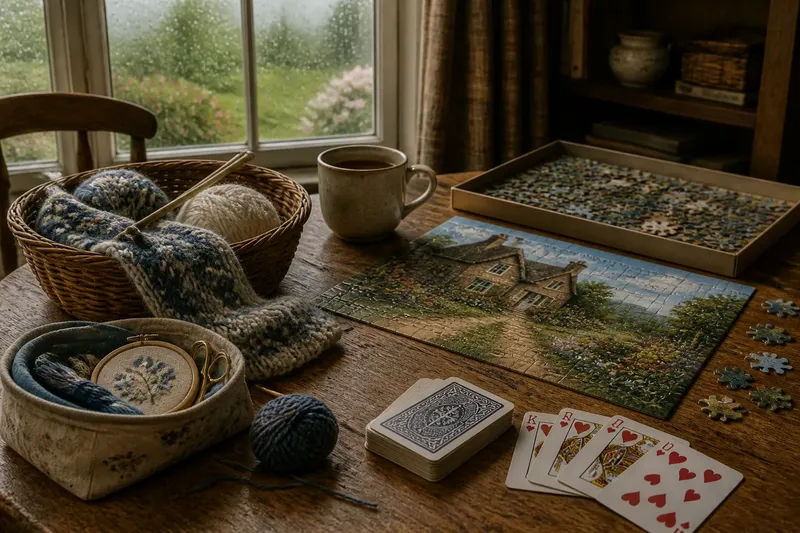
Cards, puzzles or handwork for a rainy afternoon each suit a different kind of pause indoors: cards bring conversation, puzzles reward shared attention, and handwork gives one person a steady task. Choose by the table, the company and how likely everyone is to head outside when the clouds break.
Choose by pace
A deck of cards starts quickly. Shuffle, agree on a familiar game and deal; a short hand gives newcomers a natural pause to ask questions, while longer rounds suit a group ready to stay put.
A jigsaw puzzle moves at the pace of looking. Some people sort edge pieces or colors; others scan the picture and place a piece when they spot a fit. Since it has no turns, someone can join the table briefly without interrupting anyone’s concentration.
Handwork—such as knitting, mending, embroidery or simple paper folding—has a steady rhythm. Repeated motions can be absorbing, and a small task can make sense in a busy room. It suits someone who would rather keep their hands occupied than follow changing rules.
Match the company
Cards work best when the group agrees on a game that fits its mood. A familiar trick-taking game asks players to watch one another’s choices; a simple matching game is easier for mixed ages or people who prefer less strategy. If guests want to chat while playing, choose a game that tolerates distraction.
A puzzle is cooperative without requiring everyone to act as one team. One person can search for pieces while another pours tea or talks from the next chair. A picture with distinct areas, such as a cottage, garden and sky, offers several places to begin; broad, similar colors call for more patient searching.
Handwork is easy to share without making everyone do the same thing. One person might darn a sock while another knits; a beginner can fold paper or sort buttons for a sewing project. Detailed stitching or counting may call for a quieter corner, though simpler work can accompany conversation.
Make stopping simple
Rain can lift while a game or project is underway. Cards are easy to pause between rounds: gather the deck, or agree to finish the current hand before putting it away.
A puzzle needs protection from elbows, pets and a sudden need for table space. A puzzle mat or spare board lets the work move off the dining table; otherwise, keep the box image nearby and set pieces in a shallow tray. Decide whether the aim is to finish a section or simply enjoy searching.
Handwork usually pauses cleanly when the current stitch, row or folded piece is complete. Put the needle in its case, tuck the yarn into a bag and place a scrap of paper beside the work to mark the next step. Like a bookmark in a book, this setup preserves your place without requiring you to finish the task.
What fits your afternoon?
Which pastime needs the least setup?
A deck of cards usually needs only a clear patch of table and agreement on a game. Handwork is also quick to begin if its materials are already in a basket; a puzzle needs enough clear surface for accessible pieces.
Which works for mixed ages?
Choose a card game with a simple aim and short turns, or let younger players sort puzzle pieces by color and shape. Paper folding or threading large beads may be more approachable for beginners than precise stitching.
Can people come and go?
A puzzle welcomes people for a few minutes at a time, and handwork can be set aside at a natural stopping point. Cards are flexible between rounds, though someone leaving mid-hand may require the group to pause or agree on a substitute.
What if the weather clears?
Choose cards or a small handwork project if you expect to leave the table soon. A puzzle can still suit uncertain weather if you have a way to cover or move it without scattering pieces.
A short trial
Say a family is waiting out a shower at a cottage, with a deck of cards, a half-finished scarf and a small puzzle on the table. Everyone wants to talk, and the sky looks as if it may clear, so they choose a short card game. They finish the round, put the deck back in its box, and leave the scarf folded in its basket and the puzzle pieces gathered in a shallow tray; the table is clear for stepping outside, and both unfinished projects remain contained for another rainy spell.
The choice comes from the group’s mood, not from trying to use every pastime at once. For a rainy afternoon, cards, puzzles or handwork offer lively turns, open-ended searching or steady making. Keep materials near where people naturally gather, and leave each activity in a state that is easy to resume when the weather changes.