A Small Record of a Day Out, Made Before You Get Home
A small record of a day out keeps a place’s distinctive details through a captioned photo, ticket, or sketch, without turning the outing into a reporting task.
A small record of a day out is strongest when it captures one detail you could not have found anywhere else. A hand-lettered sign at a village fair, the bell over a shop door, or the smell of wet stone by an old bridge can make a brief note feel rooted in a particular place.
Rather than keep a running account, choose one way to preserve that detail: a captioned photograph, a ticket, a quick sketch, or a few words in a notebook. Think of the choice as selecting a postcard, not building an archive; the useful part is the detail that brings the outing back to mind.
Choose one record
Different forms suit different moments. A photograph can preserve a pattern or arrangement, while a written phrase is better for a sound, smell, or small exchange that a picture cannot hold. A ticket or leaflet can provide a place name and date, but it may need a short note to explain why you kept it.
Use the form that makes sense for the detail, rather than collecting several versions of the same moment. If you take a photograph, add a caption that names the place and what caught your attention. If you keep a paper item, write a few words on its reverse or on a slip tucked beside it.
Make details identifiable
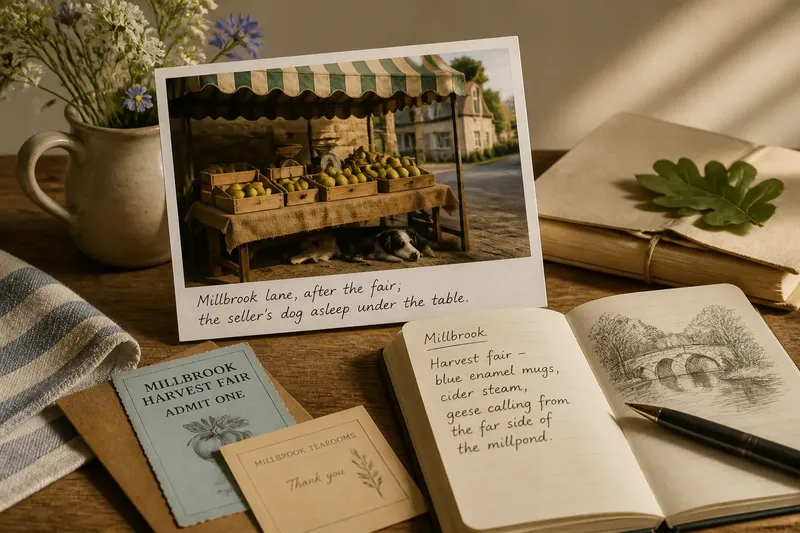
A note such as “lovely view” can fit almost any walk. Replace the general judgment with something visible or audible: “the church tower appeared between two beech trunks” or “geese called from the far side of the millpond.” A precise detail gives the memory a setting without requiring a full account.
Include a place name or a nearby landmark so the record remains clear later. “Blue enamel mugs, cider steam” may bring back a market stall for a while, but “blue enamel mugs at the Millbrook harvest fair” gives the phrase a stronger anchor.
Say you have a photograph of a produce stall after a village fair, with pear boxes under a striped awning. You write the caption “Millbrook lane, after the fair; the seller’s dog asleep under the table.” The result is one image tied to a place and an observed detail, rather than an unexplained picture among many.
Keep the record lawful
A keepsake does not have to be something taken from the landscape. Removing a flower, shell, stone, or piece of wood may harm a place or break its rules, and an object may belong to someone else. When collection is not clearly permitted, leave it where it is and preserve the impression with a photograph, sketch, or phrase instead.
A ticket, leaflet, café receipt, or paper napkin from a place where it is offered to visitors can serve as a physical reminder. Check posted rules at managed land and heritage sites, and follow the land manager’s guidance. If ownership or permission is unclear, do not take the item.
Choose a format for?
What is better, a photograph or a written note?
Choose a photograph for a visual arrangement, shape, or color that may be hard to describe. Choose a note for a sound, smell, or thought, and add a caption to either format if the place or subject might be unclear later.
What if I remember the outing only on the way home?
Write one place name and the detail that remains clearest, even if the rest of the day has blurred. Leave uncertain names or identifications marked as uncertain instead of filling gaps with guesses.
Can I keep a natural object as a keepsake?
Only do so where collection is allowed and the object is not protected, privately owned, or part of a site’s heritage. If you are unsure, leave it in place and record its appearance with a photograph or sketch.
How can I keep the record from becoming a chore?
Make one caption, save one paper item, or write one short phrase; there is no need to document every stop. Choose the detail that gives the outing its character, then leave the rest of the day unrecorded.
Make a lasting label
Before putting a note or object away, add enough context to identify it: a village name, an event, or a nearby landmark. If you keep records from several outings, place each one in a notebook, envelope, or box and label the outside with the place or occasion.
A small record of a day out needs an anchor more than an account of every moment. A caption such as “Millbrook village green, spring fair” can make a ticket or photograph meaningful when you come across it later, while leaving the outing itself free of paperwork.